How much does a short film cost in India? A rupee guide for 2026
Joydeep Roy Choudhary, Filmmaker & Founder of Atomi · 10 November 2026
Short answer: most independent short films we have seen budgeted in India cost between ₹1.4 lakh and ₹9 lakh, for 2 to 5 days of shooting. That is about ₹50,000 to ₹2.3 lakh per shoot day. Most sit between ₹70,000 and ₹1.5 lakh a day.
But the number on your budget is not what decides the final cost. Planning does. A first film rarely goes over because of the camera. It goes over because a location fell through, an actor cancelled, or a costume was not on set.
This guide gives you the numbers first, then the part that matters more: where the money really leaks.
Where these numbers come from
Two places.
First, real budgets. We studied short film budgets made between 2018 and 2026 by Kolkata filmmakers, including films from Atomi's founder's own filmmaking history. We share only ranges, never one film's figures.
Second, published guides, mainly the Indian Film Institute's short film budget guide.1
One caution. Our budgets are from Kolkata, and Mumbai costs more. One crew marketplace puts Kolkata rates at about 70% of Mumbai's.2 In Mumbai, expect the top of every range here, or above it.
The question to ask is "how many days?"
People ask what a 10-minute film costs. But a film costs money by the day, not by the minute.
Crew, gear, food, vehicles and the location are all paid per day. A 10-minute film in one room can take one day. The same 10 minutes across five locations with a night scene can take four.
In the budgets we studied, shorts were planned at 6 to 10 minutes of screen time per shoot day. So a 15 to 20 minute short usually means two or three days.
Once you know your days, the rest is multiplication.
What one shoot day is made of
Here is what indie shorts in Kolkata paid, 2021 to 2026. These are short film rates, not ad film rates.
| What | Per day |
|---|---|
| DOP (cinematographer) | ₹3,000 to ₹10,000 |
| Second camera / focus puller | ₹1,500 to ₹5,000 |
| Chief assistant director | ₹2,000 to ₹4,000 |
| Sound recordist (sync sound) | ₹3,000 to ₹4,500 |
| Make-up artist | ₹1,300 to ₹5,000 |
| Art director | ₹1,300 to ₹4,000 |
| Lightman | ₹1,000 to ₹1,900 |
| Production assistant | ₹1,000 to ₹2,000 |
| Lead actor | around ₹5,000 |
| Supporting actor | ₹1,000 to ₹3,000 |
| Compact cinema camera, basic package | ₹5,000 to ₹8,000 |
| Lighting package | ₹3,000 to ₹6,000 |
| Sound kit | ₹500 to ₹3,000 |
| A flat or house as location | ₹4,000 to ₹15,000 |
| Food, water and tea | ₹150 to ₹350 per person |
Published guides give wider ranges. The Indian Film Institute lists a DOP at ₹5,000 to ₹25,000 a day.1 A 2026 news report puts a Mumbai lightman's wage at about ₹2,000 to ₹2,200 for a 12-hour shift.3 Rental sites list a Sony FX3 body at about ₹3,200 to ₹7,000 a day.4
There is no official rate card for film crew in India. Every number here is a starting point. Then you ask the person.
A worked example: a 15-minute short, two days, one flat
This is an example we built from the ranges above. It is not a quote and not a real film.
The film: two shoot days in one flat in Kolkata. Three actors. A crew of nine. The director is also the writer and producer, and takes no fee.
| Head | How we got there | Amount |
|---|---|---|
| Crew | DOP, focus puller, chief AD, sound, make-up, art director, two lightmen, one assistant: ₹26,000 a day × 2 | ₹52,000 |
| Cast | Lead ₹5,000 × 2 days, two supporting actors for a day each | ₹14,000 |
| Equipment | Camera, lights, sound kit: ₹12,000 a day × 2 | ₹24,000 |
| Location | ₹8,000 a day × 2 | ₹16,000 |
| Food | 12 people × ₹250 × 2 days | ₹6,000 |
| Travel and goods vehicle | ₹4,000 a day × 2 | ₹8,000 |
| Props and costume | ₹8,000 | |
| Recce and auditions | ₹5,000 | |
| Post-production | Edit, colour, sound, music | ₹35,000 |
| Subtotal | ₹1,68,000 | |
| Cushion, 10% | ₹16,800 | |
| Festival entries | 10 entries at about ₹1,000 | ₹10,000 |
| Total | ₹1,94,800 |
So this small, fully paid short costs about ₹1.95 lakh. Crew is the biggest line, close to a third. The camera is ₹12,000 of it.
Now look at what a third day would add: about ₹58,000. Crew, cast, gear, location, food and travel, all over again. Hold on to that number. It explains most of what follows.
Where the money goes, in real budgets
Across the short film budgets we studied:
| Head | Share of the budget |
|---|---|
| Crew fees | 30% to 47% |
| Location, food, travel, props, costume | 21% to 23% |
| Cast | 2% to 24% |
| Post-production | 14% to 16% |
| Equipment | 11% to 14% |
Why does crew move from 30% to 47%? Mostly crew size and days. A film that adds a line producer, more lightmen and a generator team moves up fast. In one case we saw, the same three-day short was budgeted about two-thirds higher when it was planned with a full production set-up instead of a lean one.
Why does cast move from 2% to 24%? It is 2% when the leads work for a share of future earnings, and 24% when everyone takes a fee.
And equipment never passed 14%. The camera is not your problem.
What actually breaks a short film budget
This is what we have seen go wrong, again and again.
A location that is suddenly not available. The owner changes their mind, or the society objects on the morning. The crew is already there and already paid for the day. Get the permission in writing, and keep a second option.
A cast member who cancels at the last minute. Every other person on the call sheet still has to be paid. Confirm dates in writing, and confirm again the day before.
A prop or costume that is not there. This is the cheapest thing on your budget and one of the most expensive to forget. A simple pyjama that is not on set can stop a scene. Then you pay a whole unit to wait while someone runs to a shop, or you lose the scene to another day. A ₹300 item can cost you thousands.
Art that is not ready. If the set is still being dressed when the crew arrives, you are paying everyone to watch.
An over-hopeful schedule. This is the big one. Scenes are almost always underestimated. A scene that reads as half a page can take two hours. Pack 12 scenes into a day because the one-liner looks tidy, and you finish eight. The other four become an extra day.
Notice that none of these is a rate. They are all planning.
The spill-over day is the most expensive day
When a day runs late, you have two choices: stop and come back another day, or stretch the day and finish.
From experience, stretching usually costs less. An extra day means paying for everything again: camera, lights, location, vehicles, food, every fee. In our example that is about ₹58,000. Finishing the same evening means paying the crew extra for the extra hours, and in our example even a full extra shift for both lightmen comes to about ₹3,000.
Two rules if you stretch.
- Pay for it properly. Lightmen, camera attendants and helpers are often paid per shift, and a long day counts as two shifts or more. Extra hours are extra pay and extra batta. Agree the rate before the shoot, not at midnight.
- Do not make it the plan. Tired crews make mistakes and get hurt. A long day should be the rescue, not the schedule. The real fix is a schedule you can finish.
Three decisions that move your total the most
1. Shoot days. Each day you cut saves more than any discount you can negotiate. Cut scenes in the script, not hours of sleep.
2. Locations. Every new location means a move, a new permission, and lost shooting time. One good flat beats four average ones.
3. Who is paid and who is a favour. Many budgets write the director, the writer and a friend's camera as ₹0. That is fine, but write down what each favour would have cost. You should know the true cost of your film, and who you owe thanks to. And even when someone works for free: cover food and travel, give credit, and put any promise in writing. Crew work is a job.
Costs first-timers leave out
- Festivals and marketing. Every shooting budget we studied had zero here. Entries run ₹500 to ₹2,000 each in India and ₹2,000 to ₹5,000 abroad.1
- A cushion. Most budgets had none. Keep 5% to 10%.1
- Post-production. It was 14% to 16% of the total. It is where many shorts stall.
Before the shoot: a planning check
- Is every location confirmed in writing, with a back-up?
- Has every actor confirmed the dates, this week?
- Is every prop and costume bought, labelled by scene, and in one place?
- Do make-up and costume know the continuity for each scene?
- Is the set ready the evening before?
- Has someone who has shot before looked at your schedule and said "yes, that fits in a day"?
If you can say yes to all six, your budget will probably hold.
Quick answers
- How much does a short film cost in India?
- Most independent shorts we have seen cost ₹1.4 lakh to ₹9 lakh for 2 to 5 shoot days, or about ₹50,000 to ₹2.3 lakh per shoot day.
- Can I make a short film for ₹50,000?
- Yes, if you own or borrow the camera, shoot in one or two days, and people work as a favour. Your cash cost is ₹50,000. Your true cost is higher.
- How much does a 10-minute short film cost?
- It depends on days, not minutes. A 10-minute film usually needs one or two shoot days. At ₹70,000 to ₹1.5 lakh a day, plan for roughly ₹70,000 to ₹3 lakh if everyone is paid. That is our arithmetic, not a quote.
- What is the biggest cost in a short film?
- Crew fees: 30% to 47% of every budget we studied.
- What makes a short film go over budget?
- Usually planning, not prices: an extra shoot day caused by a lost location, a cancelled actor, a missing prop or a schedule with too many scenes.
- Is it cheaper to shoot outside Mumbai?
- Usually. Rates in cities like Kolkata, Chennai and Kochi are reported to be 20% to 30% lower.2
A general guide, not financial advice. Ranges come from budgets and published sources as of the dates shown. Your costs will differ, so ask for quotes.
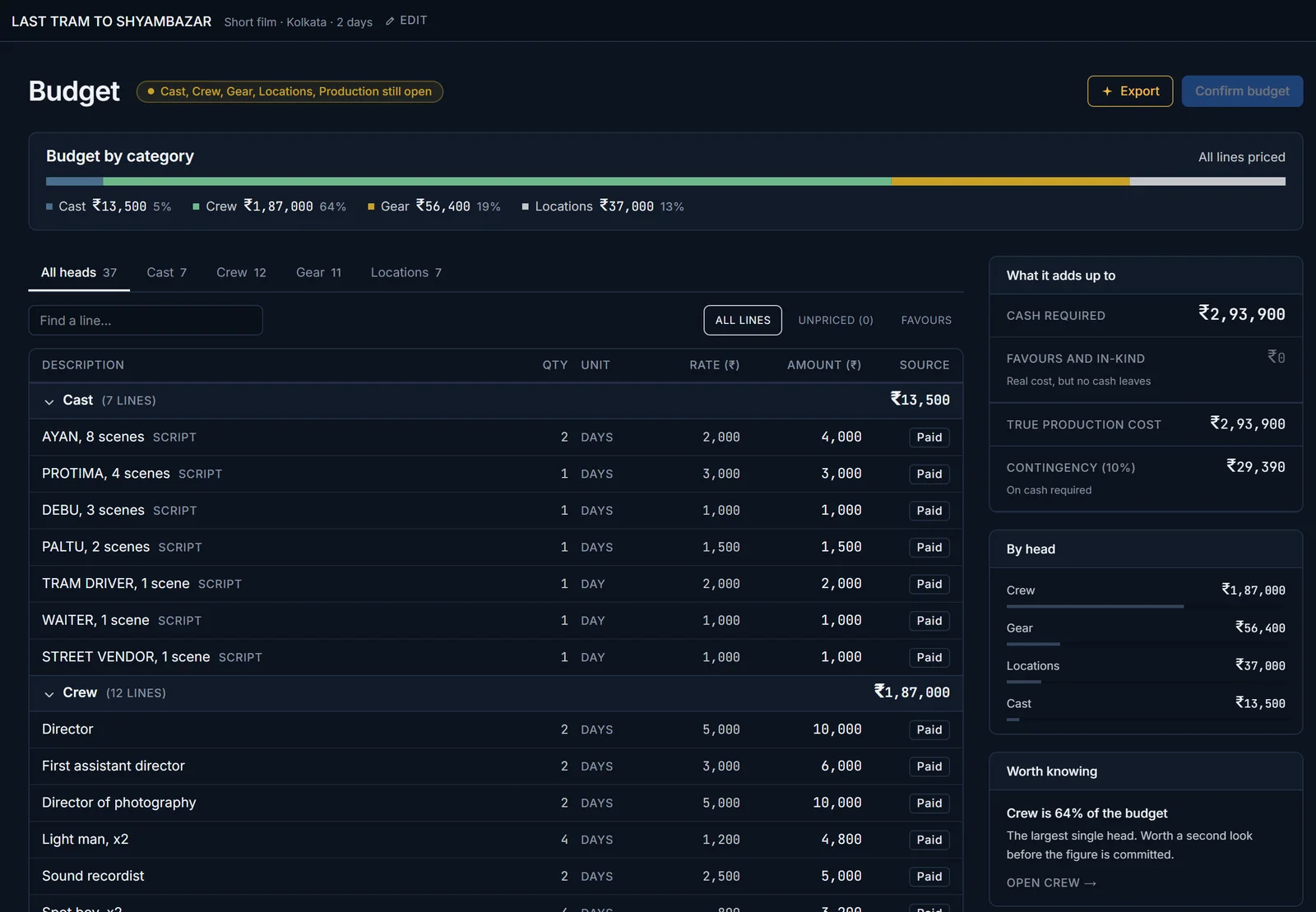
See it in Atomi
Sources
- 1.Indian Film Institute, "Breaking down a film budget: how much does it cost to make a short film in India," Kartik Dutta, 14 Jul 2025. https://www.indianfilminstitute.org/post/breaking-down-a-film-budget-how-much-does-it-cost-to-make-a-short-film-in-india
- 2.AIO Cine, "Film industry salary guide India 2026," 4 May 2026. The site describes its figures as market estimates. https://www.aiocine.com/blog/film-industry-salary-guide-india-2026
- 3.The Hollywood Reporter India, Justin Rao, 10 Aug 2026. https://www.hollywoodreporterindia.com/features/insight/overworked-underpaid-why-mumbais-film-lightmen-are-quitting-18-hour-bollywood-sets-for-swiggy-and-ola-gig-work
- 4.Listed rental prices seen in November 2026 at Primes & Zooms and RentAcross. https://primesandzooms.com/mumbai/sony-fx3.html and https://rentacross.com/mumbai/rent-camera/Sony-FX3-2833